

My 2 Year Old Is Not Talking — When Should I Get Speech Therapy?
This is one of the most common questions parents ask — and one of the most important ones to answer correctly. A two-year-old who is not talking, or who is saying very few words, can cause enormous worry. Some people say wait and see. Others say start therapy immediately. The truth is more specific than either of those answers.
This article explains what is normal at age 2, what the actual warning signs are, and how to decide whether your child needs a speech therapy assessment right now.
What is normal speech development at age 2?
By their second birthday, most children have around 50 words and are beginning to put two words together — things like "more water", "daddy gone", or "big dog". These do not need to be perfectly pronounced. What matters is that the child is using words intentionally to communicate.
By 2.5 years, most children have well over 100 words and are starting to use short three-word phrases. Speech is becoming clearer, though it is still normal for strangers to only understand about half of what a 2.5-year-old says.
Quick milestone checklist — age 2
- ✓ At least 50 words (does not need to be perfect pronunciation)
- ✓ Beginning to combine two words together
- ✓ Understands simple instructions like "get your shoes" or "put it down"
- ✓ Uses words to ask for things, not just point
- ✓ Responds when their name is called
What are the warning signs at age 2?
These signs suggest your child may benefit from a speech therapy assessment — not that something is definitely wrong, but that getting a professional opinion is the right next step.
- •Fewer than 50 words at age 2, or no words at all
- •Not yet combining two words by 24 months
- •You or close family members struggle to understand what your child is saying
- •Your child had some words and then stopped using them
- •Frustrated communication — throwing, pointing aggressively, or shutting down instead of using words
- •Limited eye contact, not responding to name, or not pointing to share interest
Should I wait and see, or act now?
"Wait and see" is advice that makes sense for minor concerns at very young ages — for example, a 14-month-old with 8 words instead of 10. It does not make sense for a 2-year-old with significant speech delays.
The research on early intervention is clear: the earlier speech therapy begins for a child with a genuine delay, the better the long-term outcomes. The brain between ages 1 and 3 is forming language pathways at a rate that will never happen again. Waiting a year to see if a child catches up on their own is a year of that window passing unused.
This does not mean every child with a small vocabulary at 2 needs intensive therapy. An assessment will tell you clearly whether your child's development is within normal range, needs monitoring, or needs active therapy. That is a much better position than months of wondering.
My child understands everything — does that mean the speech delay is not serious?
Good comprehension is genuinely reassuring. It means the language-understanding part of the brain is working well. But understanding and speaking use different brain systems and different skills. A child can have strong comprehension and still have a meaningful expressive language delay or a motor speech difficulty.
A speech therapist will assess both — understanding and expression — and give you a complete picture of where your child is in each area.
What does speech therapy for a 2-year-old actually look like?
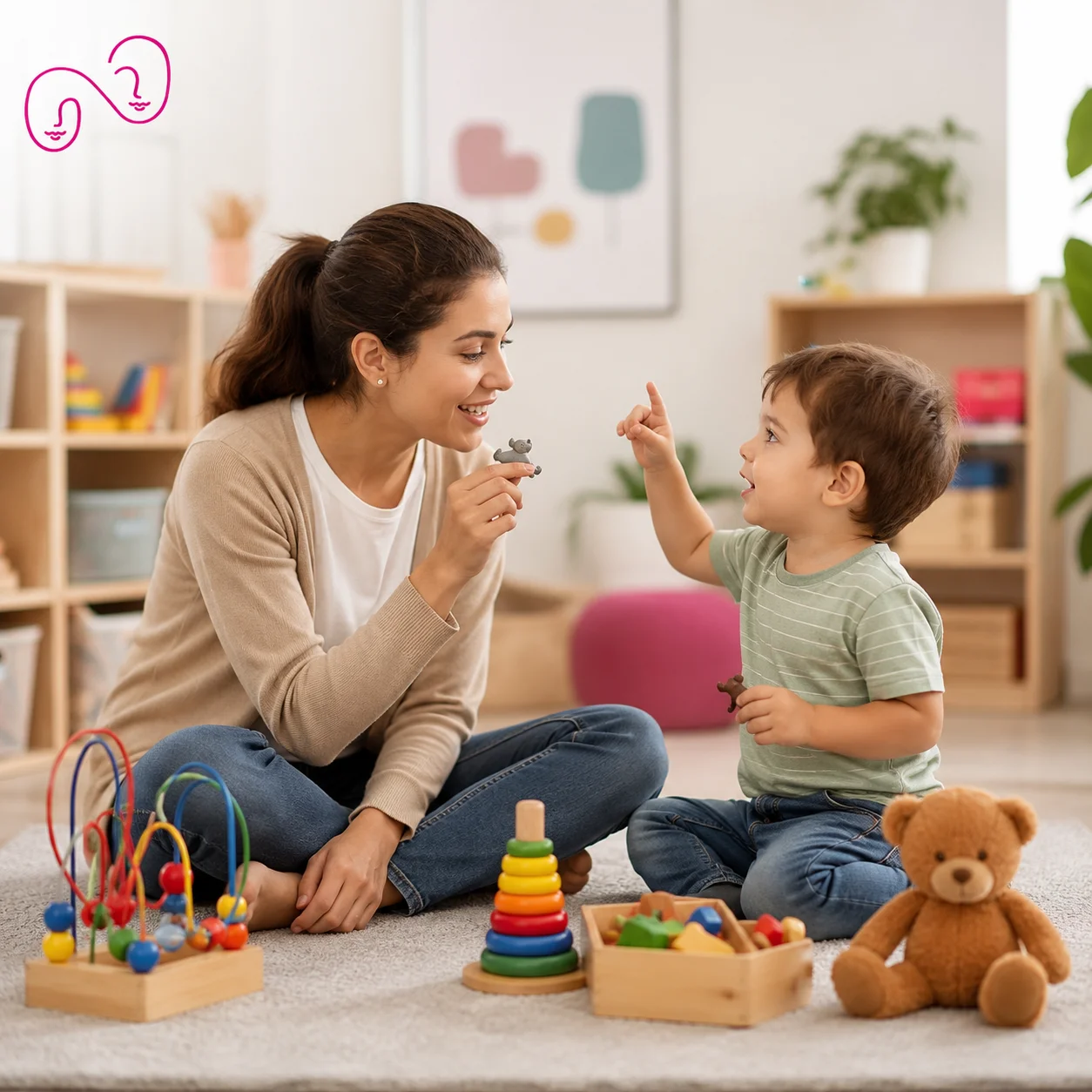
Parents often imagine a small child sitting at a table doing drills. That is not what speech therapy for toddlers looks like at all. Sessions for 2-year-olds are entirely play-based. The therapist works through toys, books, simple games, and activities the child enjoys — and therapy happens naturally within that play.
The other key part is parent coaching. At the end of each session — or during it — parents are shown specific things to do at home every day. This is critical because a child sees a therapist once or twice a week but is at home for the other 165 hours. The home practice is where much of the progress actually happens.
Is speech delay connected to intelligence?
No. Speech and language delay has nothing to do with how intelligent a child is. Many children with significant speech delays are highly bright and creative — they simply need specific support to unlock communication. A speech delay is a difference in how the brain is developing language, not a reflection of a child's overall ability.
How to book a speech therapy assessment in Ghaziabad
Beyond Therapy is based in Ramprastha Colony, Ghaziabad and provides speech therapy for toddlers and children across Ghaziabad, Vaishali, Indirapuram, Noida, Meerut, and Delhi NCR. Call +91 9899283922 to tell us your child's age and what you are noticing. We will schedule an assessment and give you a clear picture — not vague reassurance, and not unnecessary alarm.
You can also read more about our speech therapy in Ghaziabad or explore speech delay in children.