

Occupational Therapy for Autism: What It Does and Why It Helps
When families receive an autism diagnosis for their child, the advice they get often includes occupational therapy — but it is rarely explained clearly. What does an occupational therapist actually do for an autistic child? Why is it different from speech therapy? And how do you know if your child needs it?
This article answers those questions plainly, so you can make an informed decision about therapy for your child.
What is occupational therapy?
Occupational therapy — OT — focuses on a person's ability to do the everyday tasks that matter in their life. For children, those tasks include dressing, eating, playing, writing, managing sensory environments, following routines, and participating in family and school life.
An occupational therapist assesses where a child is struggling with these tasks and works to build the underlying skills that make them possible — sensory processing, motor coordination, attention, self-regulation, and independence.
Why do autistic children often need occupational therapy?
Autism frequently affects areas that OT directly addresses:
- •Sensory processing — Many autistic children are over- or under-sensitive to touch, sound, light, smell, or movement. A seam in a sock, the noise of a hand dryer, or certain food textures can cause genuine distress. OT builds a sensory diet and regulation strategies to help.
- •Fine motor skills — Holding a pencil, using cutlery, doing up buttons, and cutting with scissors all require fine motor coordination that many autistic children find difficult. OT builds these skills step by step.
- •Self-care independence — Dressing, toileting, washing, brushing teeth — these are the daily tasks that matter enormously for a child's dignity and a family's routine. OT breaks these tasks into manageable steps and builds independence.
- •Emotional regulation — Sensory overwhelm and difficulty with transitions often drive meltdowns in autistic children. OT identifies the sensory triggers and teaches the child — and the parents — how to manage them before they escalate.
- •Play skills — Play is a child's work, and it is also how children learn. Many autistic children play in restricted or repetitive ways. OT expands play skills, which in turn supports learning, social development, and cognitive growth.
What does an OT session for an autistic child look like?
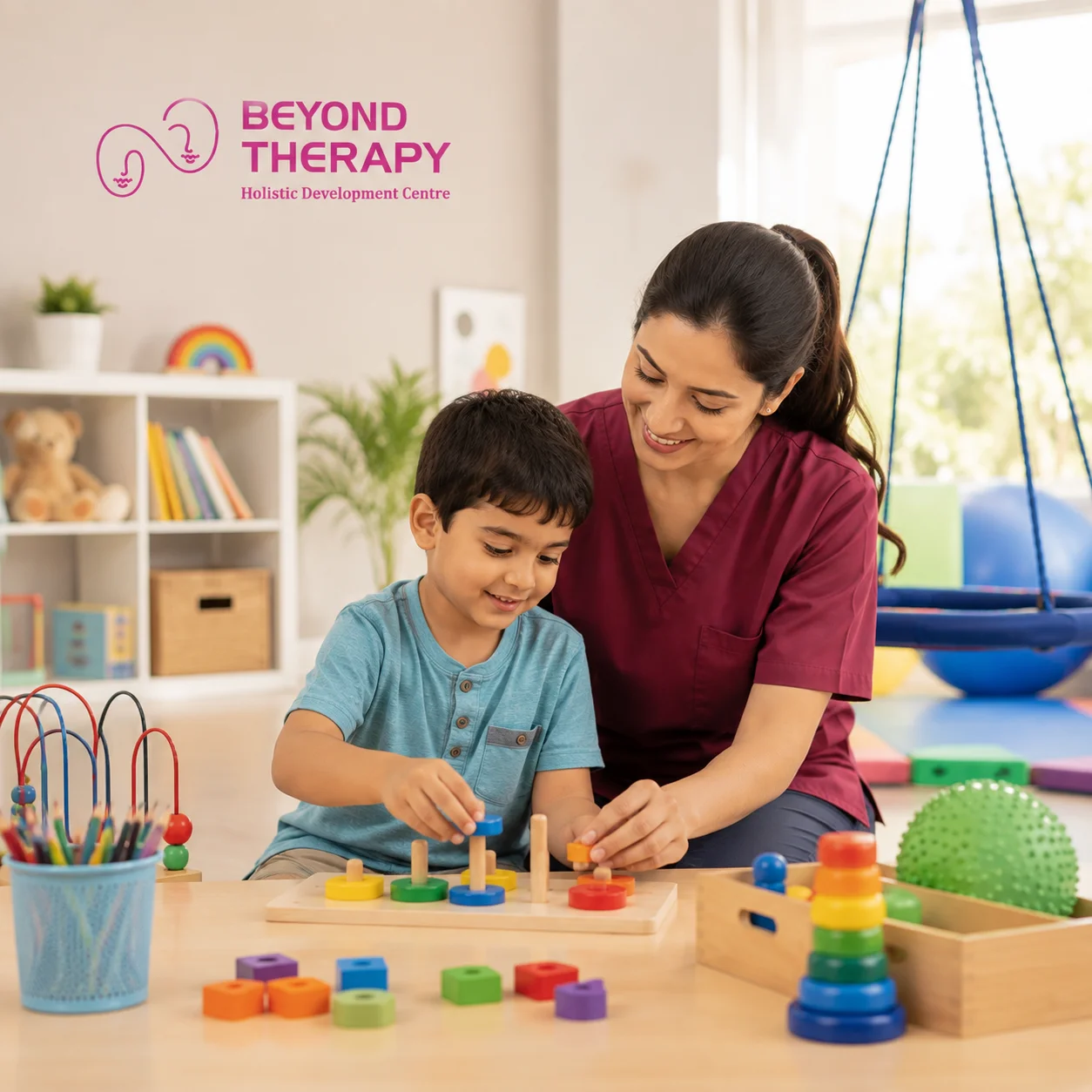
Sessions look different depending on the child's age and goals, but the core approach is always activity-based — not sitting at a table being talked at. For young children, sessions are largely play-based, with activities designed to build the specific skills the therapist is targeting.
A typical session might include swinging or jumping activities to build sensory regulation, fine motor tasks using putty or pegs, a structured dressing or self-care routine, or a specific play sequence the child is working towards.
Crucially, a significant part of each session at Beyond Therapy is dedicated to parent coaching. Parents are shown exactly what to do at home — not vague advice, but specific activities, responses, and routines that carry the therapy into daily life between sessions.
OT and speech therapy — do autistic children need both?
Many autistic children benefit from both running alongside each other. Speech therapy and OT address different but related areas:
How early should OT start for an autistic child?
The earlier the better. The brain between ages 2 and 6 has more neuroplasticity — more capacity to build and rewire skills — than at any other point in life. OT can begin as soon as concerns are identified, without waiting for a formal diagnosis. If you are seeing sensory difficulties, motor delays, or self-care challenges, an OT assessment is appropriate now.
Occupational therapy for autism in Ghaziabad and Delhi NCR
Beyond Therapy in Ramprastha Colony, Ghaziabad provides occupational therapy for autistic children and families from Ghaziabad, Vaishali, Indirapuram, Vasundhara, Noida, Meerut, and the wider Delhi NCR region. Sessions are assessment-led, play-based, and include parent coaching in every visit.
Call +91 9899283922 to discuss your child's needs and book an occupational therapy assessment. You can also read more about our occupational therapy in Ghaziabad or our autism therapy services.